AI
Product
Market
12 Min.
AI-Native vs. AI-Added Software: What's the Real Difference?

Markus Müller

There is a particular kind of fluency that is hard to learn later.
Think of people who grew up with computers, the internet, smartphones, or social media. Older generations can learn these technologies too and, of course, many become excellent at using them. Some become far more disciplined, reflective, and careful than those who grew up swiping before they could spell.
A similar distinction is emerging in MedTech software: the difference between products that add AI features to an existing system and AI-native software built around generative AI from day one.
AI itself is not new. But the rise of generative AI changed how directly it could shape product design, workflow automation, software development, data extraction, and everyday knowledge work.
Some software companies are now adding AI to products that were designed before this shift. Others were founded in the middle of it.
Flinn belongs to the second group. The company was founded as generative AI entered broader professional use, and AI has been part of how the team thinks, builds, and works from the beginning.
That affects far more than the feature list. In practice, the difference becomes visible in four areas:
How products and workflows are designed
How companies create and capture customer value
How AI quality is engineered, measured, and validated
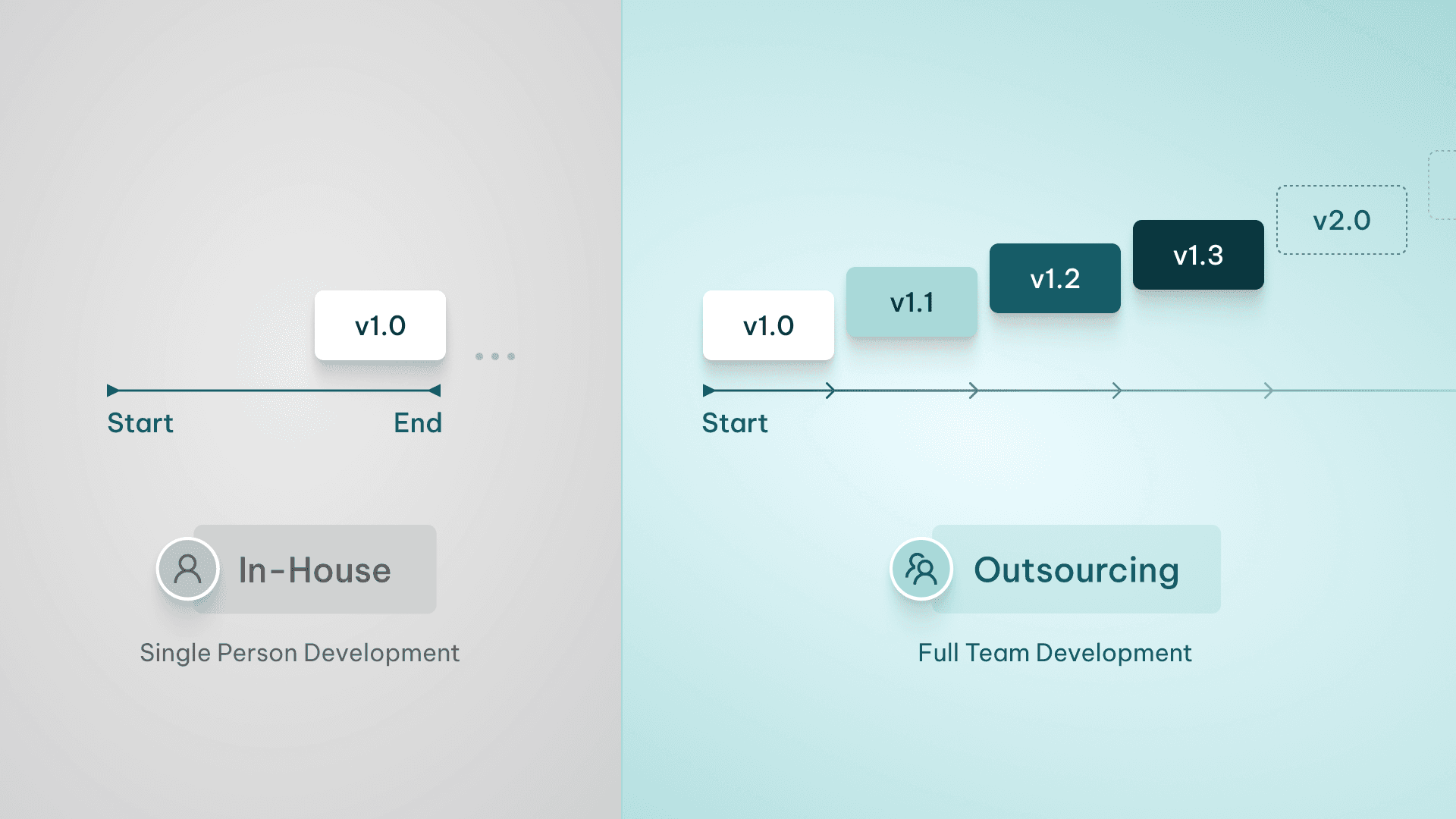
How quickly products evolve as the technology changes
These four areas provide a useful framework for understanding what “AI-native” actually means in practice.
A useful question for customers is therefore:
Was AI added later, or was it part of the foundation from day one?
1. Product Design: AI-Native Companies Rethink the Workflow
AI-Added vs AI-Native Software: Why the Difference Shows Up in the Product
One of the clearest differences shows up in the product itself.
When an established software product introduces AI, the first version often appears as an extra layer:
a chat window
a sidebar assistant
an AI button
a prompt box
a “magic” feature somewhere in the interface
Sometimes that works beautifully, sure. There are cases where an assistant-style interface is exactly what the user needs. Chat can be flexible, fast, and genuinely useful.
But there are also many cases where the AI feels bolted on:
The underlying workflow remains largely the same. Users still have to move through the same steps, only now with a small AI helper sitting next to them. The product can truthfully say it has AI. The customer can truthfully say they are using AI. Everyone gets a moment of satisfaction.
And then, a few weeks later, the actual workflow still feels strangely familiar.
This is often a product-thinking problem.
If a company starts from an existing setup, the natural question becomes: How can AI improve it a little?
An AI-native company is more likely to take one step back and look at the entire process more fundamentally: If we designed this from scratch today, would it still look like this at all?
Sometimes the answer is yes. Often, it opens the door to a very different kind of product.
Do Users Really Want to Chat with a PDF?
Take literature review software. A very common AI feature today is: “Chat with your PDF.”
At first glance, this sounds helpful for exploring a document, asking open-ended questions, or quickly understanding a complex paper. But in regulated MedTech workflows, users often need something more specific than a pleasant conversation with a very patient PDF.
They may need structured information such as device names, manufacturer information, clinical data, adverse events, patient populations, study characteristics, evidence summaries, and traceable review outputs.
If the same ten questions have to be asked of every paper, the real bottleneck may sit somewhere else. The software may simply be leaving too much repetitive work in human hands.
In that case, a better solution may be automated extraction. Or relevance screening. Or structured evidence tables. Or a workflow that surfaces exactly what the reviewer needs before they even think about writing a prompt.
And that shift changes the product logic:
AI becomes a tool for rethinking the work itself, rather than another interface pattern.
The difference can be subtle on the surface and enormous in practice. One product gives users a new way to ask for help; another redesigns the process so the same question no longer has to be asked fifty times.
Both may be called “AI-powered,” but it quickly becomes clear which one actually removes the bottleneck.
Ultimately, being AI-native doesn't mean using AI everywhere. It means knowing where AI genuinely improves the workflow and where the better product decision is to keep things simple.
The goal is not to make software feel more futuristic, but to remove unnecessary work while keeping workflows simple, reviewable, and trustworthy.
When AI-native product thinking is done well, users shouldn't notice AI at every step. They should simply feel that the work has become clearer, faster, and less repetitive.
2. Business Models: AI Changes the Economics of Software
Another difference has very little to do with the AI model, the interface, or the engineering itself.
It has to do with the business model.
Established software companies often have years of structure behind them.
This means pricing may be based on:
user licenses
seats
modules
usage time
workflow complexity
implementation services
support packages
Sales teams know how to sell it. Customers know how to buy it. Finance teams know how to forecast it.
And then AI arrives and behaves rather rudely.
It makes the customer faster, which sounds wonderful! Until the old business model realizes that faster customers may need fewer seats, spend less time in the tool, and skip steps that used to be billable.
From the user’s perspective, this is exactly the kind of progress they want.
For the vendor, it can create an uncomfortable tension. A product may be technically ready to automate more while the commercial model is still built around the slower version of the work. The obstacle is not always imagination; sometimes it is the understandable discomfort of disrupting one’s own revenue model.
AI-native companies can begin with fewer of these constraints:
They can design pricing, implementation, and customer value around the assumption that AI should make work faster instead of preserving existing inefficiencies. Ideally, the business model can be built around value creation from the beginning.
That alignment changes the incentive structure.
Because the best AI products change the economics of work.
3. Engineering, Quality, and Validation: The Difference Lives Under the Surface
Building AI Requires More Than Connecting a Model
Traditional workflow software has a certain comforting clarity:
A button does what the button does. A field contains what the field contains. A report displays the data it was told to display. Quality can often be tested through relatively predictable paths.
A demo may be smooth. A summary may read beautifully. An extracted data point may look plausible. The interface may quickly inspire trust.
Then deeper testing begins, and the picture becomes less tidy.
A system that performs well in a controlled trial may start to wobble once documents become ambiguous, uneven, or simply very real-world, missing details in one case and becoming inconsistent in the next.
That makes it easy for customers to underestimate the difference between AI features.
On paper, two vendors may seem to offer the same capabilities: summarization, classification, data extraction, relevance screening, automated document review, literature monitoring. The screenshots may look nearly identical and the workflows may appear comparable.
Under the hood, the quality gap can be huge.
Connecting to an AI model has become the easy part. The real work begins once the output has to be accurate, consistent, traceable, fast, cost-efficient, and useful on a Tuesday afternoon when a regulatory deadline is approaching.
The hard part is everything around it:
evaluation
benchmarking
prompt design
model selection
error analysis
workflow design
quality control
latency management
cost optimization
hallucination reduction
structured output design
continuous improvement
In MedTech, this becomes more than a product-quality issue. A weak AI output can create review burden, quality risk, audit risk, or the most dangerous thing of all: false confidence.
Very polished, very fluent, and very much in need of a careful second look.
A useful-looking result is only the beginning. Users need to understand what the system did, where the information came from, how reliable it is, and how the output should be reviewed. An AI-native company is more likely to build this discipline into everyday product development from the beginning.
AI Quality Measurement: The Hidden Work Behind Reliable AI Features
Strong AI companies develop ways to measure performance systematically. They build test sets, benchmark outputs, compare models, track regressions, and study failure modes closely, because "sounds convincing" is a terrible quality metric.
In regulated work, outputs need to be correct, consistent, traceable, reviewable, useful for the task, stable across relevant document types, and aligned with the workflow they are meant to support.
This is unglamorous work. Essential, yes. Likely to become the star of a product demo? Probably less so.
Customers may never see the internal evaluation pipeline. They may never see the hundreds of small decisions made to improve accuracy, reduce hallucinations, or make outputs easier to review. But they will feel the difference when the system behaves reliably in practice.
That’s one of the structural advantages of being AI-native: quality measurement becomes part of how the product keeps improving.
AI Validation in MedTech: Where Vendor Maturity Becomes Visible
Measuring AI quality is only part of the challenge. In regulated industries, the next question is just as important: How do you demonstrate that the system is fit for its intended use?
Building AI is already difficult. Validation raises the stakes again.
Unlike traditional software, AI outputs can vary. Edge cases carry much more weight, and quality is often probabilistic rather than neatly deterministic.
That creates a series of uncomfortable but necessary questions:
How do we define acceptable performance?
How do we prove the system works for its intended use?
How do we monitor performance over time?
How do we handle model changes?
How do we detect regressions?
How do we make outputs reviewable?
How do we support regulated workflows where documentation, traceability, and auditability matter?
At that point, "we use AI" is not much of an answer.
Customers need to understand how performance is monitored and how the system stays reliable once it is used in real work.
Companies that have treated AI as central from the beginning are more likely to have developed strong habits around testing, measurement, and continuous evaluation. They understand that an AI feature is only as strong as the system used to assess it.
In regulated MedTech, trust is built not only by showing what an AI feature can do, but by explaining how it has been validated.
4. Innovation Speed: AI-Native Companies Learn Differently
AI moves quickly.
New models appear and existing models improve. Costs change, context windows expand, tooling evolves. New techniques become practical and yesterday’s limitation becomes today’s default.
For companies where AI is a side initiative, this pace can be difficult to absorb.
In AI-native companies, that distance is usually shorter. AI is already part of the team's working language, so new model capabilities can move more quickly from experimentation into customer workflows. Customer feedback flows more directly into testing, and useful ideas have a better chance of becoming product improvements while they are still fresh.
This alone does not make every AI-native company better. Speed without discipline is just chaos wearing running shoes. But when speed is paired with strong domain knowledge, careful validation, and a clear understanding of user workflows, it becomes a meaningful advantage.
In regulated industries, this balance is where things get serious. Innovation cannot mean tossing new AI outputs into customer workflows and hoping the documentation gods will be kind. The goal is to improve capabilities while keeping control, traceability, and quality firmly in the room.
The companies that handle this well tend to understand AI in both ways at once: as a product opportunity and as a validation challenge.
AI-Native vs AI-Added Software: The Real Distinction Is Structural
At first glance, AI-native and AI-added software can look surprisingly similar. Both may speak the same language on a website: AI-powered features, elegant interfaces, efficiency gains, workflow automation, better insights. All good things and all very clickable.
The real difference usually appears later, once the product leaves the demo environment and enters the slightly less polite world of everyday regulated work.
For example, when:
the user applies the tool to real work
edge cases show up
the system needs to be validated
the customer asks how quality is measured
the workflow changes because AI made a better process possible
the vendor’s business model either supports customer efficiency or quietly resists it
Being AI-native creates structural advantages that are easy to miss at the beginning and hard to ignore over time. It shows up in product decisions, in the way quality is measured, in how validation is handled, in how quickly teams adapt, and eventually in the outcomes customers actually experience.
And in regulated environments, where software must be useful, reliable, explainable, and defensible, those differences are foundational.
Closing Thought: AI as DNA, Not Decoration
The market has moved beyond a simple “AI or no AI” distinction. Most serious software companies are thinking about artificial intelligence in some way, and many established vendors are building genuinely strong capabilities.
The better question is what sits underneath the label: Was AI added to an existing structure, or did it help shape the product from the beginning?
For MedTech companies, that difference can shape how useful, reliable, and defensible a product actually becomes.
Regulated work doesn’t need the loudest AI button in the room; it needs systems that know where AI adds value, where human review remains essential, and where the cleverest product decision is simply to make the work easier.
So look beyond the label. The real story is in how quality is measured, how outputs are validated, and whether the product is truly built around the work your team needs to get done!
Curious how AI-native software works in practice? Contact us.