Regulatory
8 Min.
Why Finding Predicate Devices Is Harder Than It Looks

Johannes Leitner

On paper, predicate device search can sound deceptively straightforward:
search the FDA database
identify similar devices
compare intended use and technological characteristics
select a suitable predicate
Clean, logical, manageable.
And for many 510(k) submissions, this approach works reasonably well. Regulatory teams know what they are looking for, the device category is familiar, and the relevant predicates are not exactly hiding in the wilderness.
But anyone who has spent enough time inside FDA 510(k) summaries knows that predicate device search can become more complicated than the neat process suggests.
Because predicate devices rarely stand alone.
A predicate device may have relied on earlier predicates. Those earlier predicates may have relied on others before them. Over time, individual substantial equivalence decisions begin to form something larger: regulatory lineages that can span years, companies, technologies, product codes, and sometimes decades of regulatory history.
At that point, predicate relationships start to look less like isolated comparisons and more like parts of a larger network.
That shift may seem subtle at first. But it’s not!
This article opens our short series on predicate device search with exactly that idea: finding a predicate can be the first step into a much larger regulatory structure.
The Simple Idea Behind Predicate Devices
The FDA’s 510(k) pathway is built on a relatively simple principle: a new medical device can be cleared by demonstrating substantial equivalence to a legally marketed predicate device.
In other words, a manufacturer does not necessarily need to prove from scratch that a device is safe and effective in the way a premarket approval application would require. Instead, the manufacturer can show that the new device is substantially equivalent to an existing device that has already been cleared or otherwise legally marketed.
In practice, this often creates a direct relationship:
Device A cites Device B as a predicate. Simple enough.
But Device B may also have cited Device C. Device C may have cited Device D. And Device D may belong to a regulatory moment, technology generation, or company history that looks quite different from the one in front of you today.
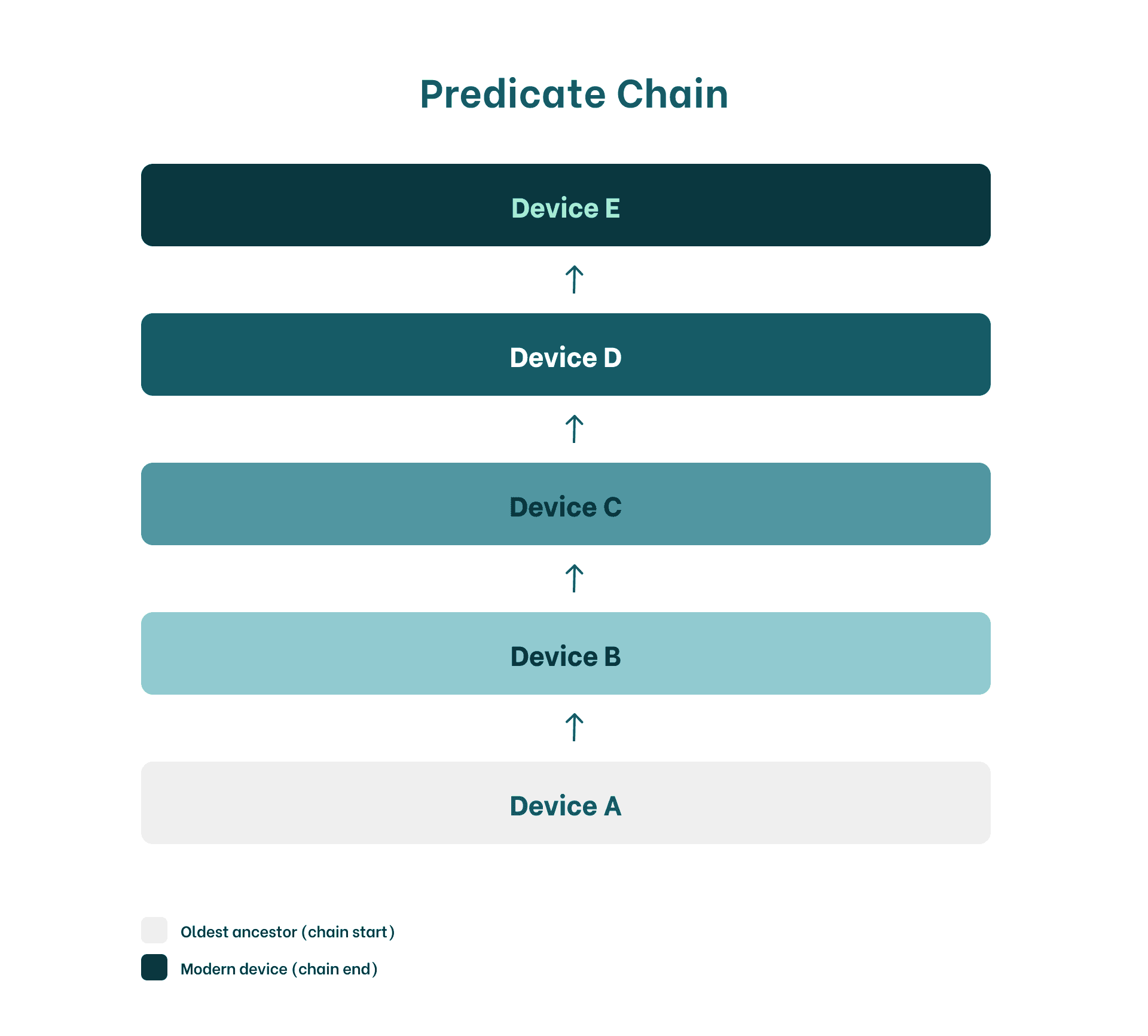
One predicate relationship is a comparison.
Many predicate relationships, accumulated over time, become a structure.
And that structure is where things become interesting!
Predicate Devices Have Histories
Most discussions about predicate devices focus on individual comparisons: Is the intended use similar enough? Are the technological characteristics comparable? Do any differences raise new questions of safety or effectiveness?
Yes, these are the right questions. They sit at the core of substantial equivalence.
But they are usually asked within the frame of a single submission.
When you zoom out, another layer becomes visible. Predicate devices are not only individual reference points, they may also act as entry points into longer regulatory histories.
A device that looks like a straightforward predicate today may sit inside a much longer chain – one that connects product generations, companies, evolving technologies, and sometimes even FDA product codes.
None of this automatically means there is a problem. It does mean that a predicate is often carrying more context than a single database result can show.
A 510(k) summary may tell you which predicate was cited, but it may not immediately show the deeper lineage behind that predicate, or how often it has influenced later submissions.
From Search Problem to Network Problem
A traditional predicate search often begins with a practical question: Which cleared devices are similar to ours?
That question is useful and remains central to the 510(k) process.
But when predicate relationships are analyzed collectively rather than one submission at a time, a different perspective begins to emerge.
Instead of looking only at individual comparisons, it becomes possible to examine the broader structures created by decades of substantial-equivalence decisions.
Those broader structures can reveal patterns that are difficult to see when reviewing one submission at a time, including:
which devices became frequently cited reference points
where product-code boundaries were crossed
how long certain predicate lineages became
how substantial-equivalence relationships accumulated over time
The point is not to replace expert regulatory judgment with a network graph and a dramatic hand gesture. (Tempting, perhaps. Not recommended, though!)
What makes this perspective interesting is not that it changes how companies choose predicates. It doesn't.
Rather, it reveals structural characteristics of the 510(k) system that are difficult to recognize when looking at individual submissions alone.
Viewed collectively, predicate relationships begin to tell a broader story about how technologies, classifications, and regulatory decisions have evolved over time.
What We Observed While Analyzing FDA 510(k) Summaries
The inspiration for this article came from a larger analysis of FDA 510(k) predicate relationships conducted as part of a customer project.
The original goal was not to investigate predicate drift or critique the FDA’s 510(k) framework. We were interested in something more foundational: what becomes visible when predicate relationships are analyzed at scale rather than one submission at a time?
The analysis included 1,435 FDA 510(k) summaries, 2,239 devices, and 2,978 predicate relationships. That scale made it possible to look beyond isolated predicate citations and start examining the relationships between them.
And once those relationships were mapped, three observations stood out.
Observation 1: Predicate Networks Can Become Surprisingly Large
The most immediate observation was that predicate relationships don’t always remain neatly contained.
In everyday regulatory work, substantial equivalence is often discussed as a comparison between a new device and one or more predicates. But every predicate may have predicates of its own. Those devices may have relied on earlier predicates as well.
Over time, this creates multi-generation regulatory lineages.
Many devices in the analyzed network were connected through only a few generations. That’s to be expected. Not every predicate search leads to a grand historical expedition through medical device regulation.
Still! A meaningful number of devices were connected through much longer chains that extended across decades of regulatory activity.
The exact chain length is not the main point here (we will explore some of the more striking examples in the next part of this series). The important point is simpler: a predicate is often not just a single reference device; it may be the visible end of a much longer regulatory history.
A device may appear as a single predicate in a 510(k) summary, while also being part of a much longer regulatory lineage that stretches across decades of submissions.
Observation 2: Product Codes Are Not Hard Boundaries
A second observation was that predicate relationships often crossed FDA product-code boundaries.
That’s interesting because product codes naturally shape how many teams think about predicate search: They provide structure, organize devices into categories and help make the FDA database searchable and usable.
Very helpful and very necessary, indeed! Also … not the same thing as a regulatory family tree.
In the network we analyzed, approximately 21% of predicate citations pointed to devices outside the original GEI product code.
More broadly, this illustrates that predicate relationships do not always remain neatly contained within FDA product-code boundaries.
When viewed as a network, connections frequently extend beyond the categories in which devices are currently classified.
This observation is not necessarily important because it changes how companies choose predicates. It doesn't.
It is interesting because it reveals a side of the 510(k) system that is usually invisible when looking at individual submissions alone.
The database category is one lens. The network is another.
Observation 3: Some Devices Become Regulatory Hubs
The third observation was the emergence of highly influential devices within the network.
Some devices appeared again and again, either as direct predicates or as ancestors of later devices. Over time, they accumulated many descendants and became central reference points in the broader regulatory structure.
Examples from the analysis included the ValleyLab Cool-Tip RF Generator, Thermage ThermaCool, LigaSure, and Valleylab Force FX.
These devices functioned almost like regulatory hubs.
That doesn’t necessarily mean they are more important clinically than other devices. And it doesn’t mean they are better, riskier, more innovative, or more representative in every context. But it means they became influential within the predicate network.
What makes these hubs interesting is not necessarily their practical relevance for predicate selection today.
Rather, they reveal how a relatively small number of historical devices can influence large portions of later regulatory activity, a pattern that only becomes visible when the network is viewed as a whole.
In a network view, these devices stand out because they connect many later submissions. They reveal how certain technologies became foundational reference points within the 510(k) ecosystem.
And once those hubs become visible, a different picture of regulatory history begins to emerge.
What This Reveals About The 510(k) System
The FDA's 510(k) framework is typically experienced as a series of individual substantial-equivalence decisions. One device cites another. A new submission builds on a previous one.
When those decisions are viewed collectively, however, larger structures begin to emerge. Long lineages, cross-code relationships, and highly influential historical devices become visible in ways that are difficult to appreciate from a single submission alone.
Looking at predicate relationships as a network may not change how manufacturers select predicates.
What they clearly do provide is a different perspective on how substantial equivalence accumulates over time and how the broader 510(k) ecosystem has evolved across decades of regulatory activity.
Why This Perspective Is Becoming More Important
Medical device regulation is built on documents. Lots of documents.
510(k) summaries, decision letters, indications, technological characteristics, product codes, submission histories, predicate citations, and supporting evidence all contain fragments of a bigger picture.
The challenge is that the bigger picture is rarely stored in one convenient place.
A human reviewer can examine individual documents carefully and that remains essential. But reconstructing large predicate networks manually is slow, repetitive, and easy to underestimate. The relevant information may be spread across hundreds or thousands of PDFs. Relationships may need to be extracted, normalized, checked, connected, and visualized before patterns become visible.
While analyzing FDA 510(k) summaries, we realized that predicate relationships reveal structural characteristics of the 510(k) system that are difficult to appreciate when looking at individual submissions alone.
Long predicate lineages, cross-code relationships, and regulatory hubs become visible only when large numbers of documents are analyzed together.
And increasingly, it is the kind of analysis where AI-assisted document processing can help uncover patterns that would be difficult to identify manually.
By structuring large volumes of regulatory information, AI can help make these otherwise hidden patterns visible across thousands of regulatory documents.
Looking Ahead: From Networks to Predicate Drift
The FDA’s 510(k) system evaluates substantial equivalence one submission at a time.
But what happens when those individual decisions accumulate over twenty or thirty years?
This is where Part 1 ends and Part 2 begins.
As we continued exploring the network, we encountered examples where modern devices remained connected to surprisingly distant technological ancestors through long chains of predicate relationships. That raises a fascinating question: Can substantial equivalence gradually shift as predicate relationships pass through many generations of devices?
This phenomenon is sometimes described as predicate drift or predicate creep, and it is where the network perspective becomes especially interesting.
In the next article, we will look more closely at one of those longer lineages and explore how individually reasonable predicate decisions can accumulate over time.
Because once the broader network becomes visible, an obvious question emerges:
How far can substantial equivalence travel before the lineage begins to look very different from where it started?
Interested in this topic? Get in touch if you'd like to learn more about our work in AI-assisted regulatory analysis.