Product
Market
10 Min.
Software Vendor vs In-House Software

Markus Müller
The real difference isn’t technical. It’s structural.
Every company hits this moment sooner or later.
You’ve found a painful workflow.
A spreadsheet has quietly turned into a system.
A “quick fix” has become something people now depend on every day.
And then someone says the magic words: Should we build something?
The honest answer? You usually have three options:
Build software in-house
Hire an agency to build something custom
Use a software-as-a-service (SaaS) provider
This article mainly looks at the first and third option, because that’s where the more interesting strategic trade-offs usually live. We’ll mention agencies briefly, because yes, they can absolutely make sense, but for most teams the real decision is simpler: Do we build internally, or do we use a vendor?
The agency option (a quick detour)
Let’s get this one out of the way first.
Agencies can make sense when:
you need something extremely specific
you want full control over requirements
you want to own the IP (intellectual property)
That’s all real.
But the trade-off is usually pretty blunt. Agencies are often expensive, and if the budget or timeline gets squeezed, quality tends to be the first thing that suffers.
In practice, for most teams comparing internal build vs external software, that’s not where the deepest strategic tension sits: That tension usually lives between building something yourself and using a specialized SaaS provider.
The first key insight
Your engineering capacity belongs to your core product
Here’s the pattern we see over and over again:
Building good software is hard.
Building good software that stays good is harder.
So the question usually isn’t Can we build it?
In many companies, the answer is technically yes.
The better question is: Should our best engineers spend their time on this?
In general, internal engineering capacity creates the highest ROI when it improves:
the core pain points of your customers
the product or service you actually sell
the revenue stream your company lives on
That’s where internal software work tends to make the most strategic sense.
But if software is mostly being used for internal automation, cost reduction, or operational workflows, the economics often start to look different. In those cases, relying on an external specialized solution is frequently the more pragmatic move.
A lot of companies end up taking a middle path at first:
assign a few internal experts to evaluate vendors
use simple workarounds or no-code tools initially
adopt specialized software once the problem becomes “real enough” in terms of volume, complexity, or risk
What usually delivers weaker ROI is building a full internal product around a workflow that already has strong specialized vendors in the market.
The staffing problem in internal software projects
In-house projects rarely get a real product team
This is one of the least glamorous parts of the decision, but it matters a lot:
Most internal software isn’t staffed like a product. It’s staffed like… a compromise.
A typical setup looks something like this:
one project manager
one or two engineers
maybe a part-time SME who’s “available on Tuesdays”
And what’s often missing?
deep product management
dedicated design
workflow specialists
domain expertise that actually stays with the team long enough to compound
That gap matters more than people think.
A SaaS company builds software across many clients, which forces its teams to become specialists in a much narrower problem space. They don’t move on as soon as version one goes live. They stay with the workflow, keep learning from it, and keep improving it.
At Flinn, for example, product managers, engineers, and designers spend years improving workflows like:
literature monitoring
regulatory monitoring
clinical documentation processes
That kind of specialization is hard to replicate internally unless you’re a very large organization that can afford to keep expert teams permanently focused on a specific operational workflow.
Project teams vs continuous product development
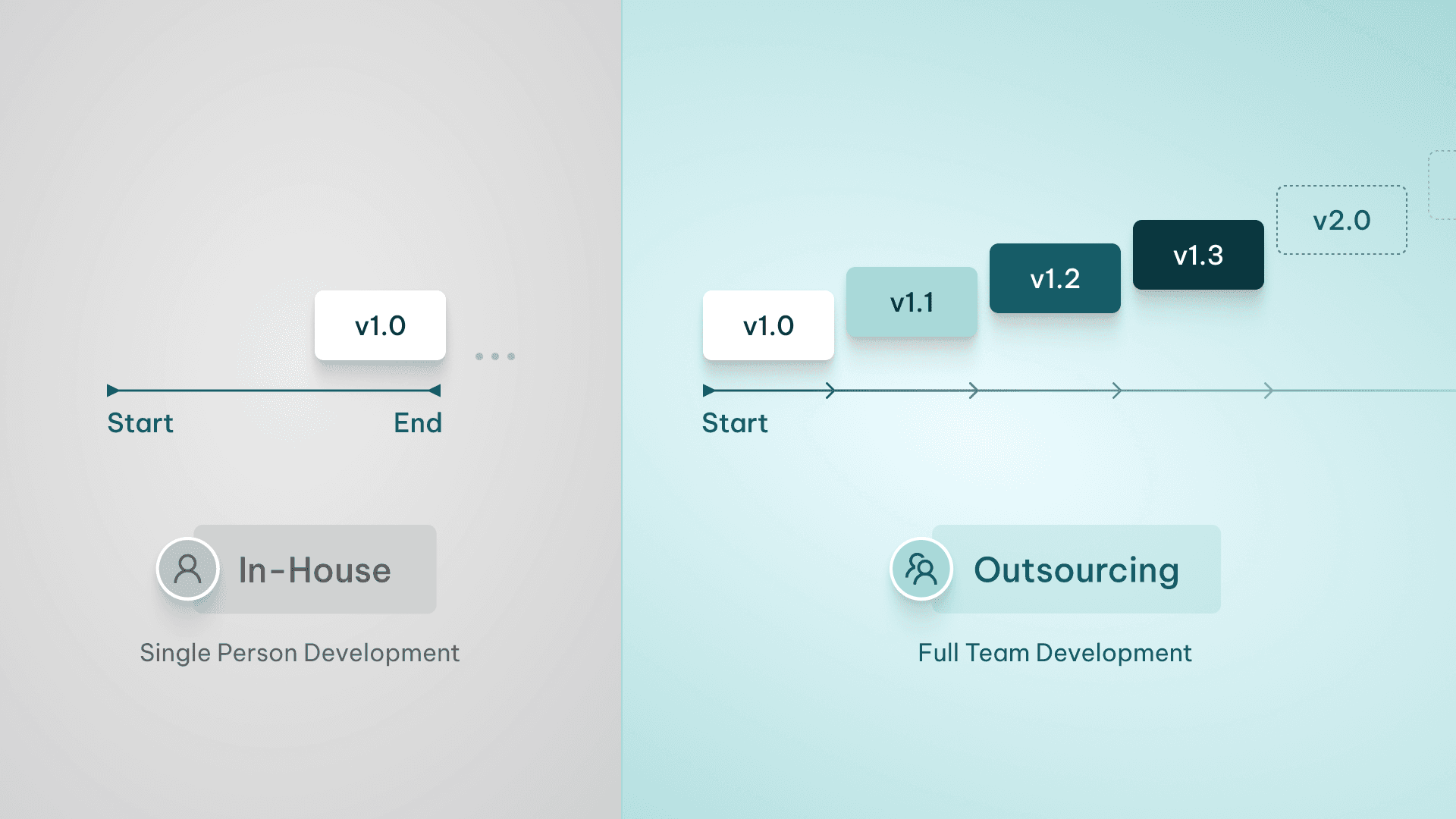
Internal software is “launched.” Vendor software is “grown.”
Most internal development gets treated like a project:
A problem is identified
A team is assigned
A first version is built
The team moves on
That structure makes sense on paper. But software doesn’t really behave like a one-off project. It’s closer to a garden than a building. It doesn’t stay “finished”, it either evolves, or it quietly decays. And yes, that sounds dramatic. But it’s also kind of true.
The reason is simple: the world around the workflow keeps changing.
new data sources
new integration possibilities
new automation opportunities
new AI models
new regulatory expectations
new operational realities
And the improvements that matter most often don’t look very impressive in isolation. They look like slightly better accuracy, slightly faster throughput, slightly less manual work, fewer edge-case failures, or fewer moments where someone has to ask, why is this export weird again?
Small things, in other words.
But over time, those small things compound.
Internal tools often miss that compounding curve. Not because nobody cares, but because once the project phase ends, incremental upgrades have to compete with whatever the next big priority is.
The economics of incremental improvement
“Software is never done” is a cost model, not a slogan
Especially now, “good enough for today” can become outdated surprisingly fast. What feels state-of-the-art now may look pretty average six to twelve months later.
And even figuring out what “better” looks like takes work: You need to benchmark models, test performance, compare speed against cost and accuracy, and in regulated settings, validate behavior properly. For many internal teams, doing that continuously is just hard to justify.
So what happens?
improvements get bundled into large, infrequent releases
iteration slows down
the tool drifts behind
users lose trust
adoption weakens
investment becomes harder to justify
That’s the vicious cycle.
Small releases compound learning. Annual upgrades usually don’t.
How AI changes the equation
At first glance, AI seems to weaken the argument for specialized software vendors.
After all, modern AI tools have made it dramatically faster and cheaper to build software.
Prototypes that once took months can now sometimes be assembled in days or weeks.
And that part is true.
But it also changes something else:
the surrounding technology landscape is now evolving substantially faster than before.
New models, frameworks, infrastructure patterns, and capabilities appear constantly. What feels state-of-the-art today may look outdated six months later.
So while AI lowers the barrier to building version one, it also increases the difficulty of continuously maintaining, improving, validating, and adapting software over time.
In other words:
AI makes software easier to start.
It does not make long-term software ownership simpler.
If anything, the opposite is often true.
Because when technology changes this quickly, the ability to continuously evaluate improvements, test new approaches, adapt workflows, validate changes, and ship small iterations becomes even more important.
And that is exactly where specialized software vendors often have structural advantages: continuous improvement is their business model, not a side project competing with internal priorities.
Why SaaS vendors can keep improving
They can share the cost across many customers
This is where the SaaS model changes the economics completely.
A specialized vendor can keep improving the product because the cost of that improvement is distributed across many customers. That makes ongoing investment viable in a way it often isn’t for one internal team serving one company.
That changes what becomes practical: adopting new technologies becomes easier to justify, workflow refinements can be shipped more frequently, and model improvements can be evaluated and rolled out more systematically.
For a single company trying to maintain that same pace in-house, the economics are usually much less forgiving, unless software development is the business itself.
Product discovery and requirements
Vendors build less “because someone asked,” and more “because it works”
Mature software teams usually don’t go straight from requirements doc to build. Or at least, they shouldn’t. They invest in discovery, prototyping, user testing, and iteration before something gets locked in too early.
The loop looks more like this:
prototype
test
refine
ship
learn
ship again
Internal projects often struggle to sustain that rhythm. Time is tight. Teams are thin. Pressure builds quickly to define requirements early and move into delivery.
So the pattern becomes familiar: requirements get written, a solution gets built, and only after rollout does everyone discover the gap between what was specified and what actually works in practice.
Then rework follows. Iteration slows down. Learning gets expensive.
Usually, that has less to do with talent than with incentives.
Teams aren’t the problem: the structure around them usually is.
Economies of scale: infrastructure and AI
Running the same thing for one company is almost always more expensive
There’s also a less visible scale effect here.
Vendors tend to get better infrastructure pricing, lower compute cost per operation, and more leverage from running similar workloads across many customers. That matters even more in AI-heavy workflows, where evaluation overhead, model choice, and compute costs can shift quickly.
If you’re running the same kind of workload only for one internal workflow, your per-unit costs are usually higher and continuous optimization becomes harder to justify.
Validation challenges (especially in regulated industries)
In regulated workflows, “trust us” is not a validation strategy
If you work in MedTech or Pharma, validation is an essential part of the job.
Specialized vendors can justify ongoing investment in standardized development processes, validation frameworks, documentation structures, and disciplined release and change control patterns.
Internal teams often treat validation as “one more thing” on top of delivery.
Some organizations do this extremely well. But many underestimate the effort, apply the process inconsistently, or build an 80/20 version of validation that looks fine right up until scrutiny increases.
And that has a real cost: every release becomes more expensive when validation isn’t standardized.
That’s one of the most underappreciated differences between vendors and in-house teams:
It changes the cost of change itself.
Support and service
When things break at 4 p.m. on Friday, who fixes them?
This is where structural differences become very real, very quickly.
With internal software, the original developers may have moved on, documentation may be incomplete, and support often exists as a side quest rather than a real function.
In practice, users end up carrying part of the support burden themselves.
With a SaaS vendor, support is part of the offering: processes are more likely to be standardized, and institutional knowledge remains even when individual team members change.
When a workflow is critical, that difference matters.
Reliability is often the line between “annoying” and “fire drill.”
A practical decision framework
When does in-house make sense, and when does a vendor win?
In-house makes sense when:
software is part of your core product differentiation
you need unique IP that should remain proprietary
the workflow is highly specific and no vendor fits
you can staff a real cross-functional team long-term
A specialized software vendor is often the better choice when:
the workflow is operational, important, but not differentiating
vendors already exist with proven depth
you need continuous improvement you can’t justify in-house
validation, traceability, and reliability matter
integrations and ecosystem fit will compound over time
Closing thought: This decision is about incentives, not ideology
The choice between in-house software and a vendor isn’t purely technical.
It’s largely about economics, specialization,and incentives.
For core products, building internally can be one of the smartest investments a company makes.
But for operational workflows, especially when specialized vendors already exist, software providers often bring:
deeper workflow expertise
faster improvement cycles
stronger validation readiness
lower long-term cost of ownership
That advantage doesn’t come from ideology. And it doesn’t come from one side being inherently smarter than the other. It comes from a business model that rewards continuous improvement of the same workflow over time.
So if you’re navigating regulated workflows like literature monitoring, regulatory intelligence, or clinical documentation, the most useful question usually isn’t Can we build it?
It’s: Should we?
If you’d like to see what a specialized, workflow-driven approach looks like in practice, we’re happy to share how teams use Flinn to operationalize regulated processes with more consistency and less friction.
Curious? Let’s talk!