Regulatory
AI
9 Min.
How to Evaluate a MedTech Software Vendor

Steven Reichen
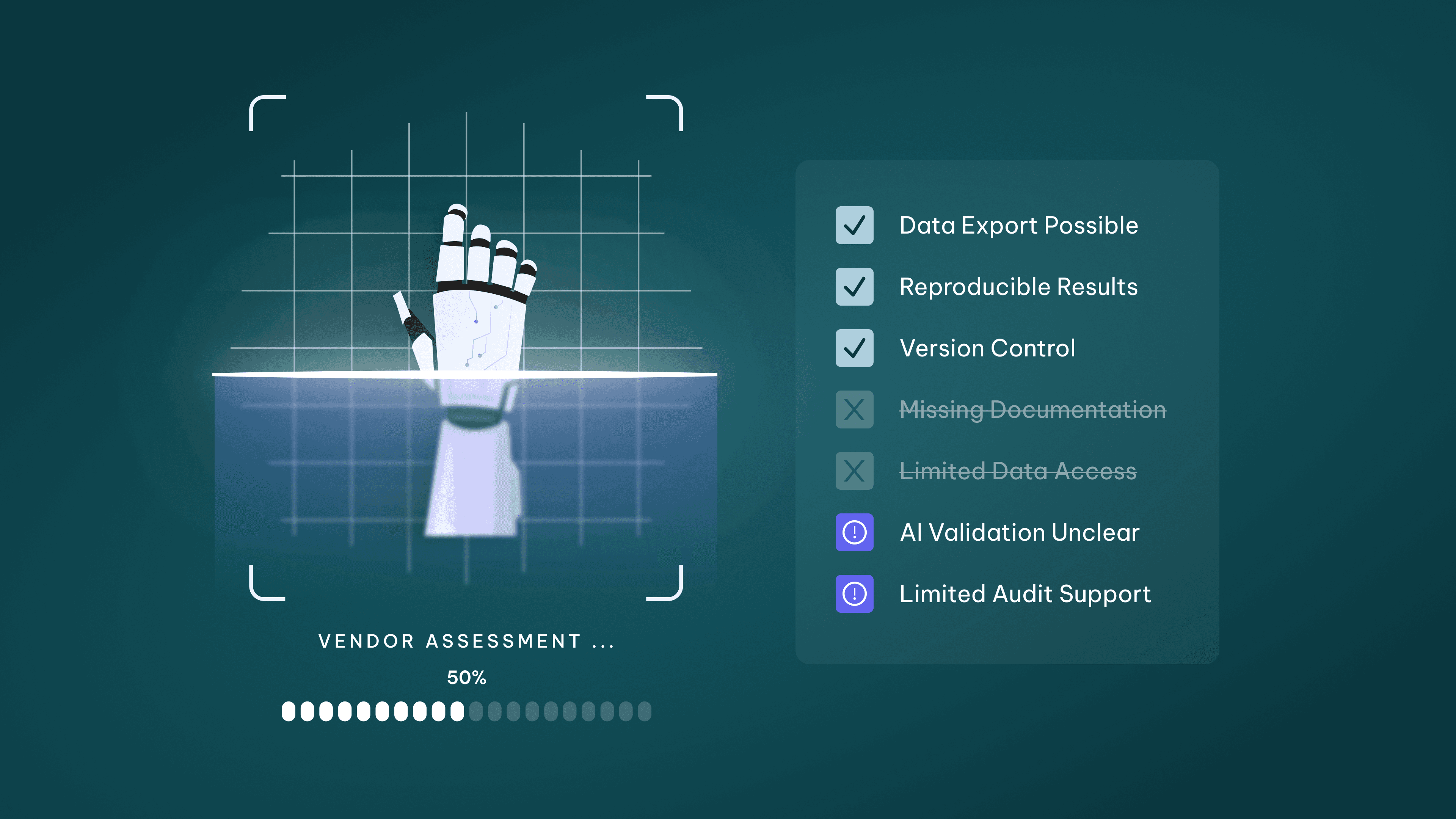
A buyer’s guide for teams who will eventually have to validate, defend, and live with the tool
A polished demo proves one thing very reliably: that someone prepared a polished demo.
Credit where it’s due, that’s not nothing. But it is also not the hard part.
The hard part begins later, when the software enters real workflows, touches regulated documentation, starts influencing evidence handling, and quietly becomes part of processes your team may one day have to validate, explain, and defend in an audit without blinking.
That is the point where ordinary software buying stops being ordinary.
In MedTech, vendor evaluation has a way of looking simple right up until it suddenly does not. The feature list looks fine, the interface is clean, the AI story arrives right on schedule.
Everyone nods and procurement feels productive.
Then a few months later, someone asks about validation documentation, release control, or model changes, and the room becomes spiritually much quieter.
So let’s save that moment for earlier.
Because the real question is never just whether a vendor can impress you in a meeting. It is whether they understand the kind of environment they want to sell into and whether their product still looks convincing once validation, audits, and change control enter the conversation.
That is exactly what a serious MedTech software vendor evaluation is meant to pressure-test.
Start your MedTech software vendor evaluation with validation
Some questions are useful because they are difficult, others are useful because they are revealing. Validation questions manage to be both.
A good place to start is this:
Which notified bodies have already evaluated your validation documentation, and what was their feedback?
A vendor familiar with regulated environments will usually recognize this question immediately and understand why it matters.
If, on the other hand, the answer drifts into confusion, discomfort, or suspiciously generic talk about software quality … Pay attention!
Vendors sometimes sell into regulated spaces while still thinking like ordinary software companies. Nice UI. Good pitch deck. Veeery little operational empathy for what happens once the tool becomes part of regulated work.
That gap rarely stays theoretical for long.
And then there is the question buyers should ask far more often than they do:
Can I review your validation documentation before we proceed?
In MedTech, this is basic diligence.
If a tool is supposed to support regulated workflows, then validation documentation is not some decorative appendix that appears after signature like a complimentary chocolate on the pillow. It’s part of the substance of the buying decision.
For many teams, this is a clean pass-or-fail point. Fairly so.
If the documentation is unavailable, weak, or mysteriously postponed until after the contract is signed, you have already learned something important. Conveniently, you learned it before paying for the lesson!
AI vendor evaluation in MedTech requires more than “trust us, it’s smart”
Now to the part of the conversation where the word AI appears and everyone is expected to become both excited and strangely uncritical.
In MedTech, that is a habit worth losing early:
Once AI touches regulated workflows, the standard should rise, not soften. A vendor does not become more credible by saying “AI-powered” with confidence.
That phrase is not a validation strategy. Sometimes it is barely even an explanation.
So ask this:
Which frameworks do you use to validate AI features?
This is where the conversation gets very real, very fast:
Classical frameworks such as IEC 62304 or ISO 80002-2 still matter, of course they do! But they don’t resolve every question introduced by LLM-based functionality, machine learning, or probabilistic extraction behaviour.
Once a system includes AI-supported features, you need more than general reassurance: You need to understand how the vendor thinks about intended use, performance boundaries, failure modes, feature-specific risk, and what exactly is being validated.
That is also where FLARE — our Framework for Levelled AI Risk Evaluation — becomes genuinely useful. It gives buyers a structured way to pressure-test whether the vendor can explain AI validation with actual rigor, rather than wrapping uncertainty in fluent language and hoping nobody notices.
Strong answers tend to be specific. They explain how individual features are assessed in context. Weak answers sound broader, smoother, and oddly allergic to detail.
Release management is where maturity stops being theoretical
Every software company says the product evolves. That’s lovely! The question is whether those changes arrive in a form that regulated teams can actually live with.
So ask:
How do you manage releases, and how much control do I have?
This is not an administrative detail, but one of the most practical questions in the entire buyer journey.
Software changes and AI-enabled software often changes faster. Models are updated, prompts are refined, extraction logic improves, interfaces shift, new features appear with cheerful release notes. None of that is automatically a problem. The problem begins when change shows up without enough clarity for customers to understand what moved, why it moved, and what that means for validated use.
A mature answer should cover things like:
versioning and change history
documentation of feature-level changes
release cadence
customer control over rollout timing
revalidation implications
If a vendor cannot explain this cleanly, the operational ambiguity does not disappear.
It simply migrates to your side of the table, where it becomes your quality problem instead of their product problem.
And that’s an expensive migration.
Then look past price, because quoted price is rarely the whole story
Software pricing has a special talent for sounding definitive while revealing very little.
In MedTech, it becomes particularly unhelpful because many costs only reveal themselves once real implementation begins and all the supposedly optional extras become oddly essential.
So ask the unglamorous question:
What is NOT included in your quoted price?
This is where vendor transparency either sharpens or starts sweating.
You want to understand the full commercial shape of the relationship, including areas like:
implementation fees
onboarding and training
support models
data migration
API or integration access
access to additional databases or content sources
audit support or customer-specific services
The interesting part is rarely the existence of these things: it’s whether the vendor presents them clearly, or leaves you to discover them in installments later like an unpleasant subscription-based plot twist.
Then ask the question that reveals the other end of the relationship:
If I want to leave, what does data export cost me?
A smooth onboarding experience tells you very little about how easy it is to leave.
And yes, that matters!
Egress fees, awkward export formats, dependency on vendor-controlled structures, and offboarding friction all tell you something important about how portable your operations really are. You may never switch vendors. Wonderful! But you still want to know whether you are staying because the product continues to earn it, or because leaving has been made strategically annoying.
Those are not the same thing.
One more question belongs here too:
What quantified time savings or ROI can you demonstrate with customers similar to me?
High-level ROI claims are easy to produce and oddly resistant to scrutiny. The useful part is not the headline number, but where the value is actually created: which steps became faster, which manual effort disappeared, what still required human review, and how any of it was measured.
In regulated workflows, value should be traceable.
Otherwise it is mostly sales arithmetic.
And even when the value is real, one question remains: how long does it take to show up in actual use?
Speed to value matters. So does what is actually being implemented.
Implementation timelines are often presented as project planning. In reality, they are also product signals.
That is why one of the most useful questions in any MedTech software vendor checklist is this:
How long until I am production-ready with my actual workflows? What is the timeline from contract signature to go-live?
The key phrase there is actual workflows:
If the answer wanders toward six to twelve months, pause. Sometimes long implementation is justified. Complex environments exist. But sometimes that timeline is telling you something less flattering: that the product depends heavily on consulting layers, manual adaptation, or vendor-side effort to become useful at all.
Thoughtful onboarding is one thing. Accidentally commissioning a transformation project is another.
And while you are there, ask the question that politely removes the stage lighting:
Can you process my real search queries in the demo right now? Can I test the software myself?
Demo data is theatre. Real queries are not!
Real queries contain ambiguity, messy phrasing, domain-specific language, awkward edge cases, and all the little imperfections product teams prefer not to place on a slide.
A vendor who is comfortable being tested on live, relevant examples is telling you something meaningful about the product itself, not merely about the performance wrapped around it.
Ask about AI architecture like you actually expect a technical answer
Plenty of vendors can tell a compelling AI story, and fewer can explain the design logic behind it without dissolving into abstraction.
In regulated environments, that distinction is not cosmetic.
So ask this:
How do you decide where to use machine learning, LLMs, and classical algorithms?
This is one of the strongest questions in AI vendor evaluation in MedTech because it reveals whether the team understands that these are different methods with different strengths, trade-offs, and failure profiles.
A thoughtful answer should sound selective and deliberate. Slightly opinionated, even.
It should make clear that:
different methods are suited to different problem types
some tasks should remain deterministic
using more AI is not automatically a sign of better design
usefulness and risk are evaluated together
That is the kind of judgment you want behind a regulated workflow: not maximum trend density, but technical restraint where restraint is warranted.
And then ask something wonderfully specific:
Can you also extract data from tables in papers?
Small question – excellent test!
Anyone can say they automate extraction.
The interesting part begins when the input gets messy, dense, inconsistently formatted, or deeply inconvenient in exactly the way scientific literature often is.
Tables are a perfect example. So are edge cases. So are structures that break elegant marketing language on contact.
Specific capability questions expose specific gaps.
A practical MedTech software vendor checklist
For teams that want the short version before the next vendor call, these are the questions worth bringing into the room:
Which notified bodies have already evaluated your validation documentation, and what was their feedback?
Can I review your validation documentation before we proceed?
Which frameworks do you use to validate AI features?
How do you manage releases, and how much control do I have?
What is not included in your quoted price?
If I want to leave, what does data export cost me?
What quantified time savings or ROI can you demonstrate with customers similar to me?
How long until I am production-ready with my actual workflows?
Can you process my real search queries in the demo right now?
How do you decide where to use machine learning, LLMs, and classical algorithms?
Can you also extract data from tables in papers?
A good MedTech software vendor checklist is simply a faster way to find out what will get awkward later.
Choosing a MedTech software vendor is a risk decision long before it becomes a procurement decision
In MedTech, software choices reach well beyond features, pricing, or an interface that photographs well in a demo. They shape future validation effort, release control, audit defensibility, and the level of confidence your teams can place in the outputs they work with every day.
The best vendors are rarely unsettled by these questions. If anything, they welcome them.
Because the real risk begins when a smooth buying process gets mistaken for operational safety. In MedTech, that confusion rarely ages well. Better to make the conversation tougher now than the consequences later!
If you would like to test these questions on a real system, we’re happy to put ours on the table – contact us.