Product
Market
8 Min.
Industry-Specific Software in MedTech & Pharma: Why Generic Tools Hit a Wall

Markus Müller
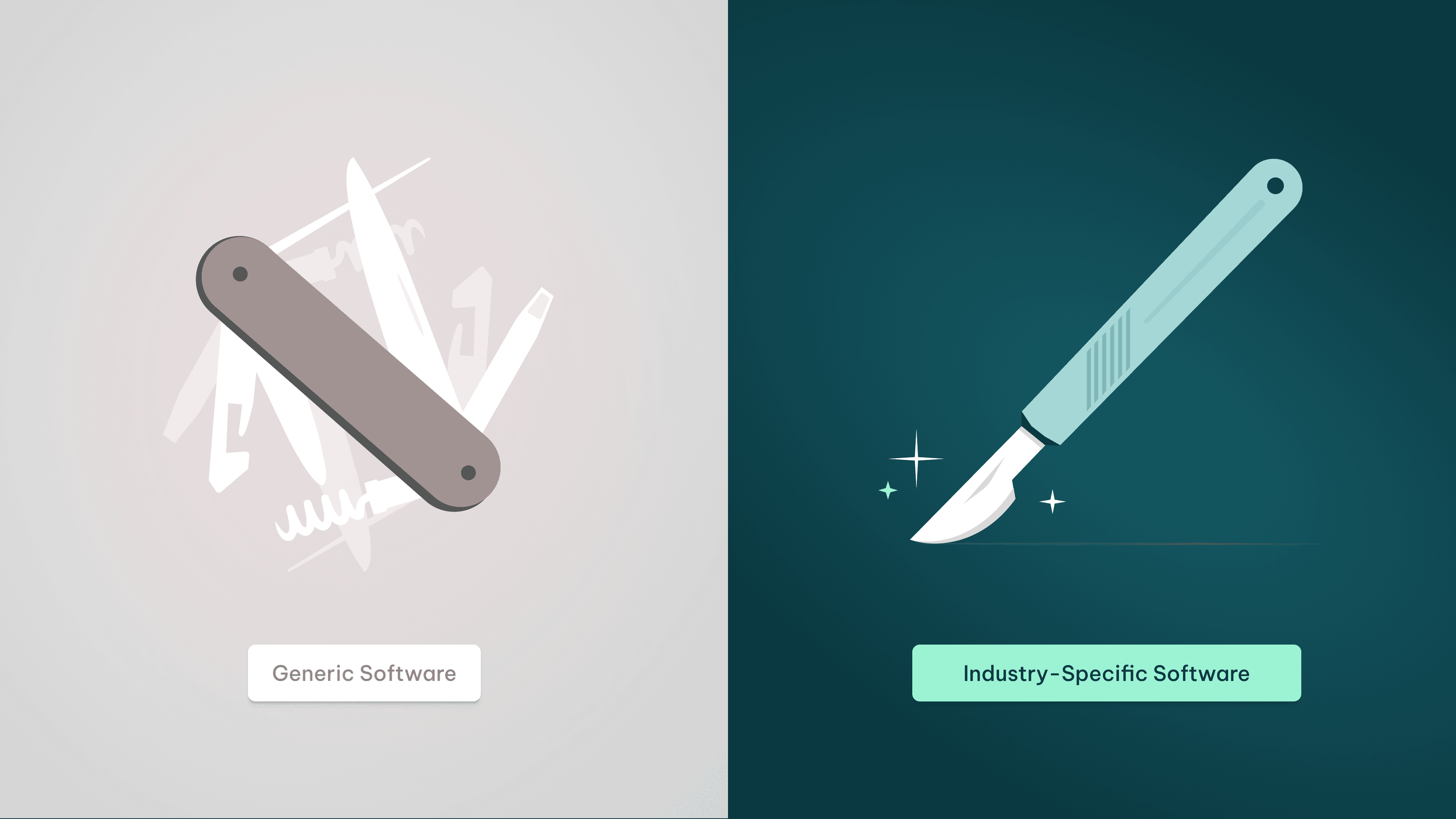
Let’s be honest: most software wants to be a Swiss Army knife.
It wants to be useful for everyone, everywhere, all the time.
In MedTech and Pharma, that ambition runs into a problem.
Because in highly regulated industries, software isn’t a generic productivity tool. At some point, it stops being “just software” and quietly becomes something far more serious:
It becomes part of your quality system.
And once software touches regulated workflows, many industry-agnostic solutions don’t “fall behind.” They hit structural limits. Of course, not because the teams behind them aren’t smart! But because the rules of the game are different.
So, why does industry-specific software consistently outperform generic solutions in MedTech and Pharma?
Let’s walk through it!
1) Is 80/20 Accuracy Good Enough?
The question that matters is surprisingly simple:
Is 80% accuracy good enough?
In many industries, absolutely!
If a system gets you most of the way there and a human cleans up the rest, that’s a perfectly fine trade.
But in MedTech and Pharma?
accuracy expectations are often extremely high
outputs may become part of regulatory documentation, where small errors can have compliance consequences
and “we’ll fix it manually” is not a strategy you want to defend under audit pressure
In regulated contexts, “mostly correct” has an annoying habit of becoming “unreliable.”
And here’s the uncomfortable truth:
Generalized software struggles to reach near-100% reliability in niche, high-stakes workflows.
Why specialized tools do better:
models and systems are tuned on industry-specific use cases
examples, edge cases, and failure modes reflect the actual domain
prompt/retrieval patterns are built around real workflows, not abstract tasks
domain expertise is embedded in the product loop
If you expect extremely high accuracy, generic solutions usually aren’t the right choice – not because they’re “bad,” but because they were designed to be broad, not deep.
2) Generic Workflow Design Comes With Hidden Trade-Offs
Industry-agnostic providers often serve multiple domains:
construction, aviation, finance, life sciences… you name it.
Even if they offer something “relevant” (literature workflows, requirements tooling, regulatory monitoring), the workflow still has to work across contexts.
That leads to the usual compromises:
generic workflows
broad feature sets trying to “fit everyone”
configuration-heavy setups
prioritization skewed toward the biggest customer segments
Life sciences is often not the biggest segment.
Industry-focused software tends to feel different immediately. Instead of forcing teams to adapt their processes to the tool, the tool reflects the regulatory workflows they already follow.
And there’s an important nuance that often gets missed:
Even within MedTech, team size changes everything.
A regulatory team of 1–2 has different needs than a team of 50+. The narrower the target group, the more relevant the workflow design becomes.
3) Validation Is the Whole Game.
Here’s the sentence that separates regulated software from “helpful tools”: In MedTech and Pharma, validation is mandatory.
(For a deeper dive into how software can be validated in regulatory workflows, see our FLARE validation framework.)
When you introduce software that touches regulated processes, you typically need to demonstrate:
it works as expected
it produces reliable results
it behaves predictably
changes are controlled and assessable
That means validation scenarios, structured test cases, and documentation.
Now add AI.
Validation gets harder, because you’re validating behavior, not a static rule set.
This is where industry-agnostic tools commonly fall short:
no structured validation support
validation (if any) limited to the initial release
no robust “gap validation” when features change
AI behavior shifts without a validation-ready trail
Specialized providers can build validation into the product approach:
structured validation documentation
predefined test cases aligned to regulated workflows
expected behavior evidence
release-related gap analysis (so you don’t revalidate everything every time)
This reduces both:
the upfront validation burden
and the ongoing effort whenever updates ship
And that’s not a small UX perk, but a structural advantage.
4) Your Subscription Fee Should Improve the Product for You. Does It?
Development capacity is limited. Let’s make it concrete:
Every software provider has to decide where to invest that capacity and not all of it will necessarily go into improving the product for your specific use case.
Imagine a software provider can build five integrations per year.
For an industry-specific provider, those five integrations are highly likely to be relevant for MedTech or Pharma customers.
For an industry-agnostic provider, those same five integrations are spread across multiple industries. Some may not be relevant to regulated life sciences at all.
That dilution compounds over time.
So when you pay an annual fee (say €50,000), the real question is: How much of your money is invested in making the product better for your use case?
In industry-agnostic platforms, it’s common that a meaningful portion of features, templates, exports, and integrated data sources are not directly relevant to medical device manufacturers, yet development time still goes into building and maintaining them.
With a specialized provider, investment is concentrated:
roadmap relevance stays high
value increases more predictably year over year
the “future value” of your subscription compounds faster
In regulated industries, that compounding effect is the difference between “tool adoption” and “workflow transformation”.
5) Integrations & Ecosystem Fit: Relevance Creates Scale Effects
Here’s a simple economic law of software:
The more customers use the same integration, the better it gets.
Because it becomes rational to invest in:
stability
depth
edge cases
maintenance
usability at scale
In MedTech, integrations often live inside a very specific ecosystem.
A concrete example: Polarion.
A system widely used for requirements and lifecycle management in medical device development.
Flinn provides a dedicated Polarion integration designed for this environment.
(Read more about our Polarion integration here.)
When many MedTech customers rely on the same integration, it becomes economically rational to invest in it deeply. The integration becomes more stable, more flexible, and continuously refined over time.
Industry-agnostic providers often don’t offer such domain-specific integrations at all. If they do, they are frequently implemented as one-off custom projects, expensive to build and rarely refined further.
Relevance creates scale. Scale creates stability. Stability creates trust.
6) Focus Makes Software Feel Simpler (Even When It’s More Powerful)
Over time, generic tools accumulate features for many different industries:
additional report types, export formats, templates, and workflow variations.
Many of these features may not be relevant to your specific context, but they still appear in the interface.
The result?
clutter
cognitive overload
accidental complexity
longer onboarding
higher chance of “doing the wrong thing correctly”
Industry-focused software often feels simpler not because it has fewer features, but because it has fewer irrelevant features.
7) Support Quality: Domain Depth Changes Everything
Specialization doesn’t just change the product; it changes the service experience.
With a specialized provider:
support sees the same regulatory patterns repeatedly
the team speaks the industry’s language
onboarding becomes faster
guidance becomes more targeted
feedback loops become sharper
With industry-agnostic providers, you get breadth.
But in regulated workflows, depth is what prevents expensive mistakes.
Quick Decision Framework: Tool or Regulated Workflow System?
Ask yourself:
Will outputs need to be audit-ready?
Do we need validation support and change control over time?
Are workflows built around real regulatory processes, not generic tasks?
Are integrations concentrated in our ecosystem, or diluted across industries?
Will this product become more relevant to us each year, or less?
If those questions matter (and in MedTech/Pharma they usually do), you’re not buying a generic tool. You’re selecting infrastructure that will live inside your quality context.
Flinn vs. Generic AI Tools (A Practical Example)
Generic AI tools can be very useful for brainstorming or one-off productivity tasks. But regulated workflows come with very different requirements, as discussed earlier.
Purpose & validation
Flinn: purpose-built for regulatory and compliance workflows in MedTech, designed with validation expectations in mind
Generic AI tools: general productivity assistants, typically not validated for regulated use cases
Workflow
Flinn: guided end-to-end workflows (e.g., database search → screening → extraction → audit-ready reporting)
Generic AI tools: fragmented, step-level support across tools without a unified, governed workflow
Controlled outputs & hallucination risk
Flinn: specialized models + workflow controls designed to reduce hallucinations by design and keep outputs reviewable
Generic AI tools: flexible outputs that vary by user/prompt/context and carry inherent hallucination risk
Compliance & auditability
Flinn: standardized, traceable outputs intended for audit expectations
Generic AI tools: ad-hoc responses that are hard to standardize, reproduce, and defend
One important nuance: AI doesn’t have to mean “chatbot.”
In regulated workflows, the most useful AI often runs behind the scenes: multiple specialized agents performing plausibility checks, verifying consistency, executing tasks, and attaching traceable references.
That is the difference between a helpful assistant and a system designed to become part of your regulated workflow infrastructure.
Closing Thought: “Generic” Has a Ceiling in Regulated Industries
Industry-agnostic tools can be excellent – within the boundaries they were designed for.
In MedTech and Pharma, software isn’t just about speed.
It shapes how compliant work is produced, documented, and defended and that changes the question entirely:
Are you buying a tool, or are you investing in a structural advantage?
If you're exploring how to implement AI in regulated environments, feel free to get in touch – we’re happy to walk you through our approach.